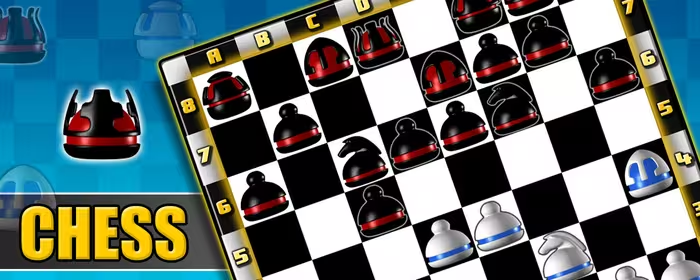
Play Chess960 and Fischer Random Chess Online
Freestyle Chess, also known as Chess960 or Fischer Random Chess, is a chess variant that changes the starting position of the back-rank pieces while keeping the familiar rules and objective of chess. Instead of beginning every game from the same setup, you face a new position that encourages you to think for yourself from the very first move.
If you enjoy chess but want less reliance on memorized opening theory, Freestyle Chess offers a different challenge without changing what makes chess compelling: calculation, tactics, strategy, piece coordination and checkmate.
What Is Freestyle Chess, Chess960 or Fischer Random Chess?
Freestyle Chess, Chess960 and Fischer Random Chess refer to the same chess variant. Before each game, the pieces on the first and eighth ranks are placed in one of 960 legal starting positions. The pawns remain on their usual squares, and Black's setup mirrors White's.
The unusual starting position is the main difference from standard chess. Your queen, bishops, knights, king and rooks may all begin on unfamiliar squares, so standard opening sequences often no longer apply.
The goal, however, is unchanged: checkmate the opposing king. The pieces move normally, and the usual rules of check, checkmate, stalemate, promotion and en passant still apply.
Why Is Chess960 Also Called Fischer Random Chess?
The names Chess960, Fischer Random Chess and Freestyle Chess are commonly used for this style of chess. The name Chess960 refers to the 960 possible legal starting arrangements of the pieces on the back rank.
On FlyOrDie, the variant is called Freestyle Chess. The name reflects the character of the game: familiar chess rules, but without a fixed opening position dictating the first phase of every game.
Whatever name you use, the idea is the same. Instead of beginning from the traditional chess position, both players must first understand a position they may never have seen before.
How the Chess960 Starting Position Works
The back-rank pieces are not placed completely at random. Every starting position must follow a few rules:
- The two bishops must begin on opposite-colored squares.
- The king must begin somewhere between the two rooks.
- Black's back rank mirrors White's arrangement.
- The pawns remain on their normal starting squares.
These restrictions produce exactly 960 legal starting positions. Some positions allow rapid development, while others require more work to coordinate the pieces or prepare castling.
Both players always receive the same mirrored setup, so the random starting position itself does not give one player a different arrangement from the other. The challenge is to understand the position more quickly and use your pieces more effectively.
How Is Chess960 Different From Standard Chess?
In standard chess, experienced players may recognize the opening after only a few moves. Familiar openings can lead to positions that have been studied extensively and may follow known theory for quite some time.
In Chess960, that preparation is much less useful. Since the pieces begin in different places, you need to examine the board before deciding how to develop.
Questions that are often answered automatically in standard openings become important again: Which pieces can develop easily? Which ones are blocking each other? Where is the king safest? Which files and diagonals could become important?
This makes position evaluation, development and piece coordination important from move one.
Do Normal Chess Rules Apply in Fischer Random Chess?
Almost all of them do. The pieces move exactly as they do in standard chess. Knights still jump, bishops move diagonally, rooks move along ranks and files, and pawns move and capture normally.
Check, checkmate, stalemate, promotion and en passant remain part of the game. The main rule that needs some additional explanation is castling.
How Does Castling Work in Chess960?
Castling in Chess960 can look unusual because the king and rooks may begin on different squares. The important point is that after castling, the king and rook finish on the same squares they would occupy after castling in standard chess.
- After kingside castling, the king finishes on the g-file and the rook on the f-file.
- After queenside castling, the king finishes on the c-file and the rook on the d-file.
The usual king-safety restrictions still apply. The king cannot castle while in check, through an attacked square or into check, and the required path must satisfy the castling rules.
The move can look strange the first few times you encounter it, especially when the king or rook already begins close to its final square, but the underlying idea is consistent across all 960 starting positions.
Why Opening Memorization Matters Less
One of the main attractions of Fischer Random Chess is that memorized opening variations are much less useful. You cannot assume that your usual first move, development scheme or opening setup makes sense in the position in front of you.
Instead, you need to look at the actual board. A bishop may already have an excellent diagonal. A knight may begin on an awkward square. A rook may be unusually close to the center. The king may require a completely different development plan before castling becomes practical.
General chess principles still matter, but they need to be applied to the specific position rather than followed automatically.
What Should You Look at Before Your First Move?
Taking a few moments to examine the starting position can prevent many early mistakes. Before moving, consider:
- King safety. Where is your king, and how easily can you prepare castling?
- Piece development. Which pieces already have useful squares available?
- Blocked pieces. Are any bishops, knights or rooks difficult to activate?
- Central control. Which pawn moves help you influence the center?
- Coordination. How can you bring your pieces into the game without getting in each other's way?
There is usually no need to invent a complicated plan immediately. First understand what is unusual about the position, then develop accordingly.
Why Chess960 Is Well Suited to Online Chess
Chess960 works particularly well online because the platform can generate a legal starting position instantly and set up the board automatically.
Each new game can begin from a different arrangement, so consecutive games are less likely to repeat the same opening. This makes rematches particularly interesting: the opponent stays the same, but the strategic problems can change completely.
Online play also removes much of the practical inconvenience of setting up an unfamiliar Fischer Random position by hand. You can simply enter the game, inspect the position and start playing.
What Skills Does Freestyle Chess Develop?
Freestyle Chess tests many familiar chess skills, but several become especially important because you cannot rely as heavily on known opening positions.
Position evaluation matters immediately. You need to decide which pieces are well placed, which need improvement and where the important weaknesses may appear.
Piece coordination also becomes more visible. An unusual starting position can leave pieces competing for the same squares or make development less straightforward than in standard chess.
Adaptability is another major part of Chess960. Instead of trying to force the position into a familiar opening structure, you need to respond to what is actually on the board.
Finally, the variant rewards independent calculation. Once the game begins, both players quickly enter positions where understanding and calculation matter more than remembering an established move order.
Is Chess960 Harder Than Standard Chess?
It depends on what you find difficult about chess.
Chess960 can initially feel harder because familiar starting patterns are gone. Even experienced players may need time to work out how to develop their pieces or where the king should go.
On the other hand, players who dislike studying large amounts of opening theory may find Fischer Random Chess more approachable. You still need solid chess fundamentals, but you are less likely to lose simply because your opponent remembers a long theoretical variation that you do not.
Stronger players still benefit from better calculation, positional understanding and tactical awareness. Chess960 does not remove chess skill; it changes where that skill is tested.
Is Chess960 Good for Beginners?
Beginners can play Chess960, although it helps to understand the basic rules of standard chess first. The variant encourages you to pay attention to development, king safety and piece activity rather than simply copying familiar opening moves.
At the same time, beginners should remember that the unusual starting positions can make development less obvious. If a position looks confusing, start with simple questions: Which pieces can I develop? Is my king safe? What is my opponent threatening?
Those questions are useful in standard chess too.
Tips for Playing Better Chess960
- Study the starting position before moving. Do not automatically play a familiar opening move.
- Check your king and rooks. Understand how castling will work in the current position.
- Develop the awkward pieces. Pieces with limited mobility may become difficult to activate later.
- Do not rush pawn moves. Moving a pawn may open one piece while permanently restricting another.
- Look for unusual tactics. The unfamiliar placement of queens, bishops and rooks can create threats very early.
- Stay flexible. A good plan in one Chess960 position may make little sense in the next.
A useful first step is to identify which pieces can enter the game naturally and which ones will require preparation. That simple assessment often gives you the outline of an opening plan without needing any memorized theory.
Freestyle Chess, Chess960 or Fischer Random – Which Name Should You Use?
You will encounter all three names. Chess960 emphasizes the 960 possible starting positions, while Fischer Random Chess is another established name for the same variant. On FlyOrDie, the game is called Freestyle Chess.
The rules do not change with the name. If you are looking for Chess960 online, Fischer Random Chess online or Freestyle Chess online, you are looking for the same basic form of chess with randomized back-rank starting positions.
Play Freestyle Chess Online on FlyOrDie
FlyOrDie lets you play Freestyle Chess online against other players. Each game begins from a legal Chess960 starting position, giving you a new development problem to solve before the familiar middlegame and endgame skills take over.
If you are looking for Chess960 online, want to try Fischer Random Chess, or simply want a break from familiar opening positions, FlyOrDie Freestyle Chess gives you a way to play the variant directly against other players.
Examine the starting position, find a plan, develop your pieces and see where the game takes you.