The two players move their pieces in opposing directions, in continuous track in the shape of a horseshoe. Both players move their pieces towards their own home board on this track.
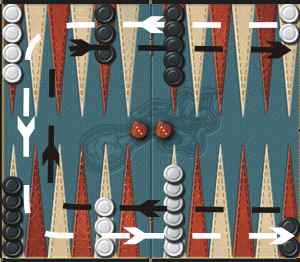
The starting player throws two dice (done automatically in the game). The roll of the dice indicates how many points the player is to move his pieces. The pieces are always moved forward. The following rules apply:
- A piece may be moved only to an open point, one that is not occupied by two or more opposing pieces.
- The numbers on the two dice constitute separate moves. For example, if a player rolls 5 and 3, he may move one piece five spaces to an open point and another piece three spaces to an open point, or he may move the one piece a total of eight spaces to an open point, but only if the intermediate point (either three or five spaces from the starting point) is also open.
- A player who rolls doubles plays the numbers shown on the dice twice. A roll of 6 and 6 means that the player has four sixes to use, and he may move any combination of pieces he feels appropriate to complete this requirement.
- A player must use both numbers of a roll if this is legally possible (or all four numbers of a double).